
Introduction
Fire safety is a major consideration in the design, construction and maintenance of commercial and industrial facilities. Manufacturing plants, transportation equipment, machinery enclosures and technical installations often operate in environments where heat, electrical systems and mechanical processes create potential fire risks.
Selecting appropriate materials is therefore an important part of responsible product design. Manufacturers must consider not only the physical performance of individual components but also their behaviour when exposed to elevated temperatures or potential ignition sources.
Among the specialist materials available to industry, fire-resistant flexible foam has an important role in applications requiring both acoustic performance and additional fire protection.
Understanding Fire-Resistant Foam Materials
Foam is widely used across manufacturing because it is lightweight, adaptable and available in different densities and configurations. Depending on its composition, it can provide cushioning, insulation, sealing and sound absorption.
However, standard foam products are not automatically suitable for environments with demanding fire performance requirements.
Specialist formulations undergo additional treatment to improve their resistance to combustion. This allows manufacturers to incorporate foam into applications where fire behaviour is an important part of the material specification.
Class 0 Foam is a specialist treated material designed for applications requiring specific fire-performance characteristics. Acoustafoam describes its impregnated Class 0 product as being treated with a mineral compound to provide a nil burn rate.
Such materials can be particularly useful when designing components for industrial equipment, vehicle interiors and technical installations.
It is important, however, to verify the relevant test classification and applicable regulatory requirements for each project rather than assuming that a material designation automatically satisfies every fire safety standard.
Why Fire Performance Matters in Manufacturing
Industrial environments can involve several potential sources of heat and ignition. Electrical equipment, engines, generators, heating systems and production machinery all require appropriate consideration during product development.
Materials positioned near these systems must be selected according to their operating conditions.
A fire-resistant foam component may help manufacturers address material requirements in areas where conventional foam would be unsuitable.
There are several reasons why this matters.
Equipment protection: Materials used inside machinery enclosures and equipment compartments must be compatible with the expected operating environment.
Vehicle manufacturing: Automotive and commercial vehicle interiors may require specialist materials for acoustic treatment, insulation and component integration.
Building services: Heating, ventilation and air-conditioning installations can benefit from carefully selected materials that meet project-specific performance requirements.
Marine applications: Marine equipment and vessel interiors often require materials selected for demanding environmental and safety conditions.
Considering fire performance during the design stage can help manufacturers avoid costly material changes later in production.
Combining Acoustic Absorption With Fire Resistance
Fire performance is not the only consideration when selecting specialist foam. In many industrial applications, sound absorption is equally important.
Generators, engines, compressors and other machinery can produce substantial noise. Without suitable acoustic treatment, sound may travel through equipment housings and surrounding structures, creating uncomfortable conditions for operators.
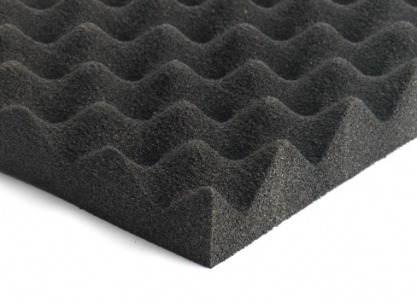
Specialist foam profiles can help reduce reflected sound energy within suitable enclosures.
The structure and flexibility of the material also allow it to be incorporated into different shapes and configurations.
For example, profiled foam can be fitted to selected internal surfaces of machinery enclosures, helping manage acoustic reflections while meeting the project’s material requirements.
The correct thickness, density and installation arrangement should be determined according to the acoustic objectives and operating conditions.
Applications Across Different Industrial Sectors
Fire-resistant flexible foam has potential applications in several manufacturing and engineering sectors.
1. Automotive and Commercial Vehicles
Vehicle manufacturers use specialist foam components in cabin interiors, headliners, trim panels and equipment compartments.
These components may need to provide sound absorption while fitting around complex structural shapes.
Flexible materials are useful because they can be cut and formed to suit different vehicle designs. Facing materials may also be incorporated to improve the finished appearance and meet specific application requirements.
2. Generator and Engine Enclosures
Generators and engines produce noise through combustion, mechanical movement and exhaust systems.
Acoustic treatment inside suitable equipment enclosures can help reduce internal sound reflections. Fire-resistant materials may be considered where the operating environment and technical specification require them.
Temperature exposure must be assessed carefully, and the selected Impregnated Class 0 Foam must be appropriate for its intended position.
3. Marine Engineering
Marine equipment operates in environments where space, temperature, moisture and safety requirements can influence material selection.
Flexible foam profiles with suitable facing options can be incorporated into selected acoustic installations, including machinery compartments and other technical spaces.
The complete assembly must be assessed for the relevant marine application requirements.
4. Industrial Ventilation Systems
Heating, ventilation and air-conditioning equipment can produce noise through fans, motors and airflow.
Specialist materials may be used within suitable ductwork and equipment assemblies to manage sound transmission and reflections.
Material selection should account for airflow, operating temperatures, maintenance access and fire performance requirements.
Flexibility and Custom Manufacturing Capabilities
One of the main advantages of specialist foam is its ability to accommodate different manufacturing requirements.
Industrial components are rarely identical across every project. Equipment dimensions, enclosure shapes and installation restrictions can vary considerably.
Flexible foam can be cut, shaped and converted to fit particular applications. This is particularly useful when working with curved surfaces or complex component geometries.
Acoustafoam offers Class 0 profile materials in different formats, including sheets, rolls, faced products and profiled configurations.
The company also identifies options involving foil facings, surface coatings and composite constructions incorporating additional barrier and damping materials.
These options allow manufacturers to consider more specialised assemblies according to their technical requirements.
Important Factors When Specifying Materials
Selecting an appropriate product requires a detailed assessment of the intended application.
Fire classification should be one of the first considerations. Manufacturers should review relevant test documentation and confirm that the material meets the applicable project specifications.
Temperature resistance is another important factor. A foam suitable for a general equipment enclosure may not be appropriate for direct exposure to high temperatures.
Other considerations include:
- Density and thickness: These influence the physical and acoustic properties of the material.
- Flexibility: Important when components must follow curved surfaces or irregular shapes.
- Facing options: Suitable coverings can provide additional protection or improve integration.
- Installation: Adhesive backing and mechanical fixing methods may be considered according to the substrate.
- Maintenance: Materials should remain accessible for inspection and replacement where necessary.
A careful specification process helps ensure that the finished component performs as intended throughout its operating life.
Working With Specialist Foam Manufacturers
Businesses developing industrial products often benefit from working directly with experienced material processors.
Specialist manufacturers can help convert foam blocks, sheets and rolls into components that meet specific dimensional requirements.
Processes such as CNC cutting, waterjet cutting and precision sawing provide opportunities to manufacture repeatable parts for different industrial applications.
Acoustafoam specialises in manufacturing foam, rubber and plastic components for a variety of sectors. Its processing capabilities support customers requiring both standard material formats and bespoke manufactured components.
Early communication with a supplier can help clarify available material options, facing requirements and production considerations before a project moves into manufacturing.
Conclusion
Fire-resistant foam materials contribute to the development of components designed for demanding industrial and commercial environments. Their combination of flexibility, acoustic properties and specialist fire-performance characteristics makes them relevant to applications involving machinery, vehicles, generators and building services.
The key is to select materials according to the actual operating conditions and applicable safety requirements. By working with experienced manufacturers and reviewing technical specifications carefully, businesses can develop components that address both practical manufacturing needs and important performance considerations.